
Values in More Detail —
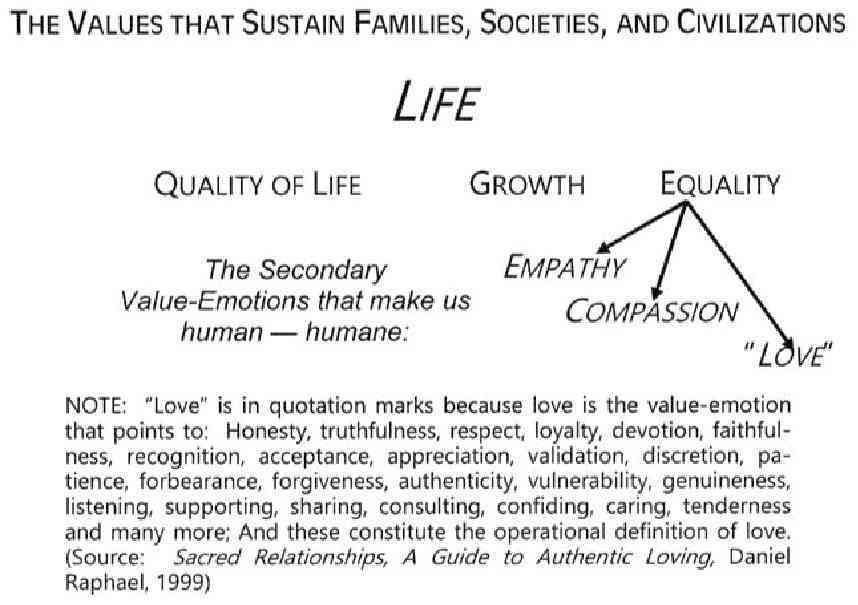
LIFE, the Ultimate Value. Life is the ultimate value. It provides the pivotal element for the existence of the other six values as a system of values. Decisions made about life are qualified by the other six values that become the criteria for human decision-making, to express the highest values of human existence and our humanity.
The three primary values, (quality of life, growth, and equality), are organic to our species and are the original cause of human motivation. This motivation has resulted in material and social progress while also giving us the capability to sustain our species over thousands of generations.
The three secondary values, (empathy, compassion, and “love”), are also organic to our species and share the same characteristics as the three primary values. They exist in us as an impulse to do good. They are proof that people are innately good, and created that way! For example, we want peace for others as much as we want peace for ourselves because we are wired with the values that make us human – humane.
These seven values are integral and provide a holism of decision-making that motivates us to progress individually and collectively, while also reaching out to others who are less able or capable of doing so for themselves. These seven values create a oneness of humanity that is only violated by willful decision-making. They provide us with the capability to choose to grow into our innate potential in the seven spheres of human development: Physical, mental, emotional, intellectual, social, cultural, and spiritual.
Quality of Life. While life is fundamental to survival and continued existence, it is the quality of life that makes life worth living and gives life meaning. In a democracy, access to the quality of life is provided when a person not only has an equal right to life, but that person also has an equal right to growth as anyone else. This is what makes immigrants so excited to move to a democracy — they seek freedom to experience the quality of life that makes life worth living — to control their own destiny and to explore their innate potential with the opportunities that a democratic nation provides.
Growth is essential for improving our quality of life. To be human is to strive to grow into our innate potential. Our yearning to grow ensures that our innate potential becomes expressed and fulfilled, and collectively encourages an improving quality of life for everyone that results in social progress.
This value ensures that the inherent potential of individuals, societies, and a civilization becomes expressed and fulfilled, which encourages an improving quality of life for everyone. Without growth, there would be
no possibility of social evolution and social sustainability. Once the population of our global civilization is balanced with our planet’s natural resources, then growth has everything to do with improving the quality of life of individuals, rather than the quantitative growth of populations to support economic growth. Until then difficult moral decisions will have to be made that move our communities and societies toward that balance.
Equality is inherent in the value of life. We give equal value to each individual, and we would seek to provide more equitable opportunity to every individual to develop their innate potential, as we would our own. Even those with less potential than others have equal value to live life to explore, develop, and express the potential they do have. Without equality, life is a competition where the resources of one’s living-potential is squandered in competitive warlike existence. Then there is no moral equity available.
The reason that we are so sensitive to issues of equality is that we have the innate capacity of empathy – to “feel” or put our self in the place of another and sense what that is like, whether that is in anguish or in joy. Feeling that, we want to act in compassion 7 – to reach out to the other and assist them in their plight.
Our motivation for equality is stimulated when we compare our own life to that of others and see that the quality of their life is “better” or “worse” than our own. Our sense of inequality then rises within us to motivate us to seek equality for us, and equality for them stimulated by our empathy and compassion for them.
We generalize empathy and compassion toward all of humanity with the term “Love” – the capacity to care for another person or all of humanity, as we would for our self.
7 http://ccare.stanford.edu/stanford-compassionate-university-project/