
Introduction —
To be truly successful in the larger holism of a democratic society, Progressives will need to re-frame their view of local, state, and national democracies to include the democracies of other nations. The world is becoming “smaller” every year, so let us anticipate upgrading the designs for all national democracies to make peace and social stability more viable.
If Progressives choose the values and principles of social sustainability to push their agendas forward, then they will become deeply involved in the social, political, and economic structural architecture of designing and implementing social sustainability practices in all realms of functional democratic societies. Such a role will need to include preparing the public to accept greater public responsibilities than historically “leaving it up politicians.”
The following proposal is unique as an effort of organizational development to increase the effectiveness, functioning, and longevity of democratic societies, governments, and economies. The proposal seeks to redirect social, political, and economic change that cripples societies, governments, and economies by incorporating the seven core values of social sustainability into organizational structures and daily decision-making processes. The hypothesis is that doing so will give organizations the same degree of sustainability as has sustained our species for approximately 200,000 years. By extension of the hypothesis, using those values will produce a cultural change of beliefs about the sustainability of individuals, families, communities, and nations. Best of all, doing so will turn organizations and governments into Type II Learning Organizations.39
When organizations begin to use these seven values, we could predict, as Peter Senge 40 suggests, that the decision-making processes of democracies will change, and that change will cause a change in behavior of citizens and leaders. We could go further and even predict that citizens and leaders will begin to think in terms of the integrated systems of democracy and social sustainability, and behave accordingly.
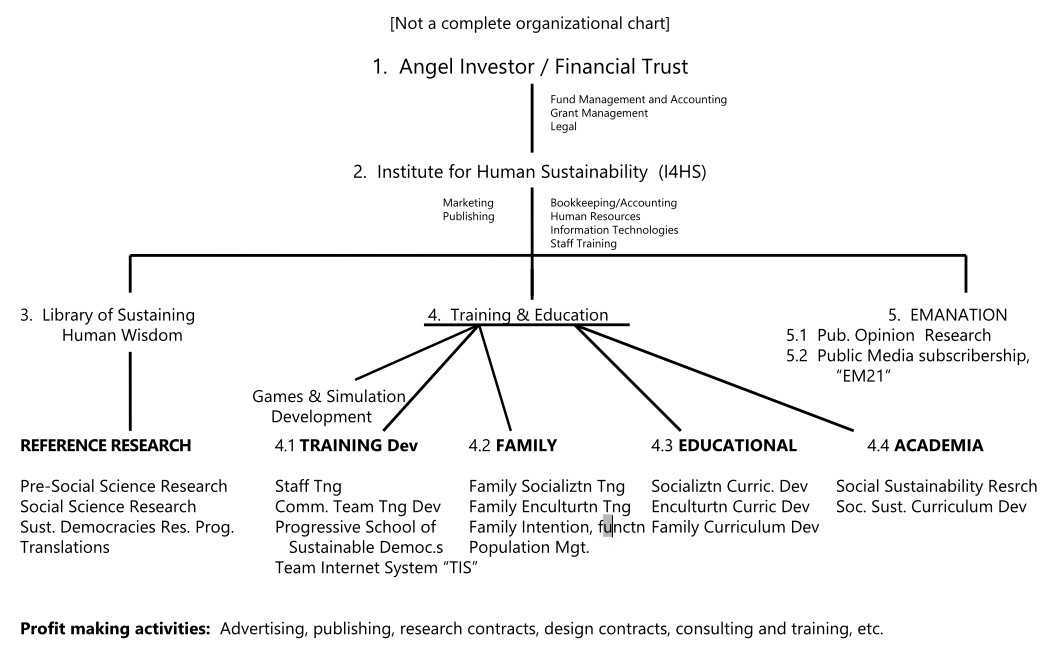
The organization chart on page 167 illustrates several organizations that will be discussed below.
1. Angel Investor / Financial Trust —
In this imaginative proposal, the Financial Trust is organized for the management and administration of grant funding provided by an anonymous angel investor. Obliquely, the investor might be a multi-billionaire who sees both an altruistic benefit and the lucrative financial potential in the concepts and principles of social sustainability. Tracking the progress and fulfillment of grants is an essential responsibility for the programs the funding creates.
Vision.
The vision of the Trust is to bring an end to the boom-and-bust cycles of growth and failure of societies, governments, economies, and civilizations.
Intentions.
- To be the benefactor to the Institute for Human Sustainability (I4HS) and its subordinate organizations; and through the functions of the Institute, to support efforts of the public to install sustainable practices in local and national organizations.
- To design and implement I4HS as a socially sustainable profit-making, partial employee-owned corporate model from start-up to profitability.
2. Institute for Human Sustainability (I4HS) —
Vision.
The vision of the Institute for Human Sustainability is to bring about the conscious, transcending social evolution of civilization.
Intention.
- To develop the necessary enculturating processes and materials to teach and train democratic societies, communities, families, and individuals how to support the social sustainability of each other.
I4HS recognizes that socially sustainable families are the foundation of socially sustainable civilizations, while socially sustainable organizations are the foundation of socially sustainable societies. For the purposes of this proposal, I4HS must model itself and operate as an adaptable organization through social sustainability practices as a type II, double loop learning organization, and corporate entity.
- Intention for the design of I4HS. As mentioned above, this will eventually become a profit-making organization from the original “angel investment.” The design-intention for profit-making is to create I4HS as a self-sustaining organization. Hopefully, it will prove that an altruistic, benevolent profit-making organization can also be neutral by incorporating the seven values into its structure and by incorporating the Type II Learning System into its organization.
As also mentioned, I4HS will immediately partner with its employees by making them 40% owners of I4HS. The long term intention for doing so is to create a new middle class of employee-owners in democratic cultures. The secondary intention is to provide a working model as an exemplar to other corporations. The third intention is to provide a sustaining model for balancing social equity, social justice, and “what is fair.”
Today, (2017), there is immense criticism of the 1% who hold 80% of the world’s assets. Yet, even those who are the very wealthiest individuals in the United States know and have acknowledged that this creates is an immense social problem of financial equity. If we fairly examine this situation, these individuals generally are not individuals with pernicious acquisitive temperaments, but are truly good investors who have made incredibly astute decisions that have resulted in their greater wealth. In other words, the financial inequity is a result of the larger financial system. At present there is no plan to change this, and if there were, given the same traditional culture of profit-making and retention, no one would know how to go about a rational system of sharing the wealth.
The proposition of I4HS to make employees immediate entrepreneurs of its operation is a solution that has many benefits, but with several requirements. Employees would need to be trained and enculturated in the ethos and culture of business management, entrepreneurship, business decision-making, and investment strategies, just as any successful entrepreneur have learned.
- The primary dividends of such a sharing-strategy is to
- Remove the divide between management and employees;
- Educate an ever-increasing number of citizens in the culture of profit-making, company ownership and management;
- Gain full access to the intelligence and creativity of employee-owners, and give knowledge-workers a sense of real ownership of their contributions;
- Develop the team concept into its greatest application;
- Reduce the 99-1% divide;
- Move retained financial assets into productive use, whether in commercial investment or in the development of employee related programs;
- And probably many others.
Philosophy.
The longest lived (sustainable) societies are those in which each individual is sustained as he or she contributes to the sustainability of his or her family, community, and society; and, symbiotically, societies become long lived as they contribute to the social sustainability of the individual, their family, and their community. Such longevity is not possible without all organizations entering into that same symbiotic relationship with individuals and their host societies. Mutually, their social sustainability is maintained by devising, adapting, and implementing more mature and effective models of institutions and systems, from the level of childrearing to global organizations to accommodate perennially inevitable social, political, and financial-economic change.
Mission.
- Develop methods that empower democratic citizens to engage social, political, and financial-economic change in ways that contribute to the stability, peace, and social sustainability of their families, communities, and societies.
- Develop methods for citizens to become informed and educated concerning public social, political, and financial-economic issues; and the methods for them to develop socially sustainable options to those issues, and the means for sharing their opinions, preferences, and knowledge with their public executives.
Desired Outcomes. The work of the Institute is to “bend the culture” of mature, developing, and emerging democracies so that the issues of social justice, social equity, and the common good become balanced, and societies become stable and eventually socially sustainable. This means that citizens will also become more responsible to improve their quality of life, to grow into their innate potential to do so, and enjoy both developments with an equal capability as anyone else would or could.
It is my belief that there exist sufficient wisdom in the history of civilizations, societies, empires, dynasties, and nations to help us understand “what works” to support social stability and peace. Further, there are sufficient intelligent people who have the capacity to make wise choices to support “what works” for the peaceful sustainability of their communities, societies, and nations.
I also believe that all that is needed are unbiased, non-aligned, and unaffiliated processes that allow hundreds of millions of citizens of democratic nations to participate in option-development, preference-sharing, and choice-making to support the creation of solutions for the benefit of the greatest number of citizens.
3. International Library of Sustaining Human Wisdom —
Intentions
- The intention of the Library is to provide a functional, ongoing repository for a growing database of SS Wisdom; a globally accessible source for that wisdom; and the capacity to support online training in 11 languages in the practical applications of social sustainability.
- The intention of the Library is to collect, store, organize, collate, catalogue, and make available, globally, all wisdom of human experience and research that contribute to the Social Sustainability (SS) of individuals, families, communities, societies, nations, and the global civilization.
The Library will be the primary source-researcher for I4HS sections, and as those programs become developed, to then serve the needs of external inquiries from local community Design and Validation Teams, and others of the public.
Pre-Social Science Research. It is my suspicion that there is a vast reservoir of historic wisdom of the failings and successes of past societies and civilizations lying fallow in the libraries of the world. The emphasis of this research is the discovery of findings that support social stability and the social sustainability of the individual, family, community, societies, nations.
The Social Science Research Program surveys published literary social research projects for historic experience, historic social research, and contemporary experience and social research of WHAT WORKS and WHAT DOES NOT WORK as validated by the criteria of the seven core values. Three areas are examined: Societal-social, political-governmental, and economic-financial based on the 7 core values.
Contemporary social science resources would include all published social science research, and ongoing social science research. Again, the emphasis is on findings that support the social sustainability of the individual, family, community, societies, nations, and the global civilization; and, are in alignment, fully or partially, with the seven values of social sustainability.
Translations. The universal nature of the seven values dictates that the practices of socially sustainable training programs become available to at least 11 major languages: English, Spanish, Portuguese, French, German, Russian, Italian, Turkish, Modern Standard Arabic, Farsi, and Mandarin — 90% of the world population. (India and Japan already use English extensively.)
4. Training and Education —
Training has responsibility to develop the training materials and training media to 1) train staff in the new field of social sustainability; 2) develop training programs for Local Community Social Sustainability Design and Validation Teams; 3) develop training materials and programs for Progressives. It would be ideal if it also became a training resource for Progressives by providing online, onsite, and in-house training programs to meet the political issue and campaign needs of Progressive candidates. We might even envision this school as becoming a training-for-candidate-selection to create a corps of professional grade public executives, whether elected or appointed.
It will provide training for citizens to confer and collaborate with other local community Design and Validation Teams around the world through the “Team Internet System.” Local community Design and Validation Teams will need to be trained how to use data in the methodology of the Schematic, to formulate design-solutions to social issues.
Education has the responsibility to adapt training to pre-K, K-12, and community college level educational settings; and to strive to establish Social Sustainability as a recognized college and university level subject of study and research.
4.1. Training Development.
Training Development’s In House Research Team will become the model for the development of training materials, processes, and settings that will be applied to other in-house SS Design and Validation Teams, and for offsite teams, and Local Community Team Training materials.
It is essential that the model (values, structure, and processes) developed by the Training Development Team becomes an effective and productive model as it will be replicated by thousands of local community SS Design and Validation Teams around the world. Computer simulation training in 11 languages will go far to support validated results from those local community Design and Validation Teams around the world.
Team Internet System (TIS). TIS is an Internet “public media” subscribership. TIS is co-responsible with the IT section to develop an effective Team Internet System (TIS) that enables Teams all over the world to network, collaborate, and contribute Validated Statements of Findings to the Library’s growing database of validated SS Wisdom.
4.2. Family.
The intention of the Family Section of Training is to develop the means and materials to train and educate individuals and families as being the primary agents of multi-generational social sustainability enculturation, (See Ch. 7, page 61). Secondly, this section is responsible with Training
Development to create training materials that teach parents and children of all ages how to enculturate children.
Teaching young adults and adults how to enculturate themselves and their children with the fundamentals of a socially sustainable family is key to the development of millions of integrated families globally.
Family is the foundation of civilizations — the first socializing and enculturating institution of next generations. It is here at this immediately personal and intimate setting that children-becoming-adults learn how live in a socially sustaining family that makes meaningful contributions, and the maintenance of socially sustainable communities and societies.
To teach pre-conception couples and individuals, as well as existing families, the fundamentals of the family as a socializing institution, how to socialize, and how to teach children how to teach their own children how to become socialized. Similarly, to develop training and educational materials to teach the young adults and grown adults the fundamentals of enculturating children in the responsibilities of being a citizen in a democratic society.
4.2a. SS Family Enculturation Training.
4.2b. Population Management. Population management is given distinctive importance by I4HS in terms of the “universality” of population practices so that it could be taught to any race, ethnicity, culture, nation, or gender. Over-population in any society and nation is a very real threat that is now being felt by nations around the world. Political, military, and economic tragedies point this out very clearly as we are now seeing with the exodus of refugees and migrants from Africa and the Middle East.
4.2c. Family Curriculum Development.
4.3 Educational.
The intention of the Educational Section of Training and Education is to support family socialization and enculturation by developing training, educational, and curricular materials to inform, educate, and train the cultures of democratic societies how to become stable and eventually socially sustainable cultures.
The focus of this section is on the development of educational curricula for private, corporate, governmental, and public educational settings. The over-arching goal is to develop materials to educate the broad organizational public about the necessary realities of initiating, maintaining, and sustaining a stable, peaceful society; and, their symbiosis with the public.
4.4. Academia.
The intention of the Academia Section is to establish social sustainability as an identifiable academic pursuit within colleges and universities with curricular programs and research activities.
5. EMANATION — (EM) —
The greatest need for a society to move into social, political, and financial-economic stability is a third player that does not take sides politically, but acts as a facilitator between the public and their government without abridging any aspect of the Constitution or the rights of individual citizens to improve the effectiveness of citizen interaction with their government; while making a profit to become organizationally and financially self-sustaining. That may seem like a wildly impossible development, but the reality of profit-making social media as Facebook, LinkedIn, Twitter, and others begs us to create a “public media” with the same or similar means of income generation.
Primary Functions.
- To develop unbiased public opinion research; educate the public.
- To provide a public media subscribership for the public so that citizens can more directly participate in how decisions are made by their public executives to create the future they will have to live out.
The overarching intention of EMANATION is to facilitate free and unbiased public dialogue between citizens, “the public,” and their public executives, “the government.” The effectiveness of EM as a facilitator of that public dialogue is dependent upon remaining neutral, and unaffiliated with special interests, non-partisan, and non-position oriented toward any social, political, or economic topic or issue.
“Emanation” is a nom de guerre for the operating organization for the program of “the emanation process,” (TEP) which encompasses the synergism of EMANATION and its subordinate operations. The emanation process provides a non-invasive, non-aligned scaling-up of public participation in the democratic dialogue between the public and their government. It oversees public opinion research concerning local, state, and national public issues; statistical analysis, interpretation, and publication of results; operation of an Internet Public Media Subscribership (EM21); and issue education for past and contemporary issues.
Philosophy. The best government is government by the governed, who must be well educated and informed. Such citizens in rational concert with their governments are best able to direct the course of their own public affairs for the advancement and sustainability of themselves, their families, communities, states, regions, nation, and civilization.
Ethics. Emanation as an organization, and responsible for its performance in a participatory democracy, must not give deference or preference to any one citizen, group of citizens, or corporation over all other citizens, but must continue to give each citizen equal access, rights, privileges, opportunities, and protections to become sustainable. Above all, it must respect the fundamental rights of equality that have proven themselves sufficient to promote the welfare of a nation of individuals and give example for other evolving democracies.
5a. Public Opinion Survey Research. EMANATION’S primary function is to measure public opinion through statistical social research: Random sampling of citizens and public executives to identify significant public issues; developing non-position educational information concerning significant public issues; sharing the results of those random sample surveys; develop and provide education materials to EM21 Internet subscribers; developing questionnaires for its subscribership to assess subscriber opinions and preferences regarding those public issues; developing and sharing data analysis and interpretations with subscribers, public executives, and media; followed by asking subscribers for their preferences to the options available to the resolution of those issues.
- Unbiased arguments are best served using neutral educational materials concerning those public issues, and that dispassionately examine the various sides of argumentation of those issues; while also pointing out the potential consequences of the various sides. Emanation, as a facilitator of fair and open public dialogue, provides unbiased articles, research materials, and Internet links that discuss the various aspects of public issues.
6. EM21 — An Internet “Public Media” Subscribership
The intention of EM21 is to provide subscribers with a non-aligned and unbiased site to learn about public issues without a political agenda other than expanding the influence of citizens to participate more directly in their governance.
Subscriber’s expanded influence becomes visible when their demographic data is used by EMANATION to make statistical projections onto similar but larger populations.
EM21 subscribers have the options of using both the statistical information and non-position oriented educational materials for those issues developed by Emanation along with the socially sustainably validated materials from I4HS Library to provide a rational argument in the public dialogue for movement toward social stability and social sustainability.
EM21 options for networking. As with social media, subscribers of EM21 can network with others who are interested in the same public issues. Those networks could then form into blocs of public opinion that are measurable by EMANATION. Obviously, subscribers within those blocs can link to the I4HS Library to discover validated designs, moral validations, and suggestions for policy analysis and policy formulation concerning those issues. If no designs are available, EM21 subscribers could contact Social Sustainability Teams through the Team Internet System (TIS) to develop socially sustainable designs or moral validations concerning those public issues.
7. Relationship between EMANATION and I4HS —
Both organizations offer the public a source of interested but unaffiliated facilitation within the context of social evolution, social progress; and, offer non-positioned, validated social options for the resolution of those issues; and, unbiased educational information that discusses various perspectives on those issues.
The interaction of both systems results in a societal Type II learning system. Combined, they provide constructive input by citizens and public executives, with ongoing measurable public sentiment. The desired outcome is that greater wisdom is accumulated to make wiser decisions, knowing what supports successes while being fully aware of what causes policy failures.
EMANATION will use many of the resources of the I4HS Library as the activities of I4HS and EMANATION will almost always involve three topic areas: societal-social, political-governmental, and economic-financial. The Library’s research teams will be primarily interested in these three areas for historic and contemporary materials that contribute to social sustainability to those areas; as well as validated findings from hundreds of local community Social Sustainability Design and Validation Teams.
I4HS, through its Library and Training programs, provides Emanation with 1) a base of wisdom from historic sources and contemporary social research sources for the development of unbiased, non-partisan information and data to develop unbiased, non-judgmental, and non-partisan articles about contemporary public issues. 2) I4HS provides a training function to local community Design and Validation Teams that choose to initiate work on developing socially sustainable designs as solutions to those public issues.
I4HS and Emanation Combined. The Institute empowers and enables local citizens in hundreds of local Teams to design socially sustainable social processes, organizations, and social policies, while EM21 facilitates public discussion and option-development of those public issues.
Answering “What works?” then becomes a bottom-up political and social process of moving communities and whole national societies toward social sustainability. “What works?” can only be answered by hundreds, thousands, of local Design and Validation Teams in democratic nations using the ageless values of social sustainability that have supported the sustainability of our species for tens of thousands of years, and have empowered us to thrive as a species. These values support ongoing social stability and also create social and cultural evolution leading to social sustainability. “What works?” becomes very visible within a maturing democracy when democratic processes and democratic institutions are designed to become sustainable social institutions.

…To enjoy privilege without abuse,
to have liberty without license,
to possess power and steadfastly refuse to use it
for self-aggrandizement —
these are the marks of high civilization.
39 Argyris, Chris. 1985. Action Science, Concepts, Methods, and Skills for Research and Intervention.
40 Senge, Peter M., 1994. The Fifth Discipline, The Art and Performance of the Learning Organization