
1 First, coupling local community citizens with the multi-generational training and education work of Clinics for Sustainable Families will result in the transcendence of democratic societies. The programs of the Clinics create the social epigenesis of positive, constructive influences upon the whole society that “bends” the course of the culture over time similarly as electronic technologies have influenced our cultures.
- Local Community Clinics for Sustainable Families would become permanent, operational social institutions in all local communities.
- Clinics would provide classes and training modules via all possible multi-media, plus personal and group venues. The target populations would include all age groups from pre-school to grandparents. Venues would include all Clinics, and educational settings from pre-school to post-graduate. Just as technology classes are provided in most schools, so too would the best practices of parenting, child rearing, child care, family dynamics, and others be provided.
Multiple generations of training and education through the Clinics would create far more peaceful and socially stable families, communities, and societies, and increase national productivity. The programs of the clinics would have the effect of decreasing social, commercial, and industrial losses due to divorce, family abuse of several different natures, mental/emotional problems, drug abuse, and other causes of loss to productivity.
Caution: I would argue against public education taking on the role and functions of the Clinics as public education has never finished its homework to devise a clear vision and intention for its existence in democratic nations, at least in the United States. The illustration on page 21 provides a hierarchy of decision-making for the vision, intention, and operating philosophy of any and all public social policy development and the function of social institutions.
The skills of effective parenting and child rearing are not hereditary.
Training as this has never been recognized as a necessity for our societies, but because of the tremendous effect that bad parenting has on the life of the child-becoming-adult a great waste of the individual’s innate potential is squandered and never shared with their community or society. Our individual and collective empathy and compassion must now come to bear upon this egregious loss.
Some of our citizens have been richly blessed by being raised by parents who seem to have known how to raise effective, socially responsible children who grew into adults and are reasonably well adjusted mentally, emotionally, and socially. Many of our citizens were not raised so conscientiously. Many of the social ills of our “modern” societies, for example child abuse, sexual abuse, elder abuse, alcoholism, drug abuse and addiction, spousal abuse, child and adult delinquency, marital unfaithfulness, gambling addictions, and many more, are almost all attributable to dysfunctional or absent parenting, child rearing, and family skills: The original cause of social-societal, political-governmental, and financial-economic dysfunction and decline.15
In any of the healing arts and sciences a choice has to be made: Does the physician treat the symptoms or heal the cause? If we see governmental leadership in the role of healing social problems, then we immediately recognize that governmental programs are almost always palliative at best. The last large-scale curative social program that treated the causes of many social problems in the US was the New Deal initiated by President Franklin Delano Roosevelt. Today’s endemic social problems must be addressed by a far more fundamental cure that begins within the family, with the parents.
What is suggested here, however, addresses the original causes of societal decline by recommending a community-based program of Clinics that helps parents create families of whole individuals who will carry the values that have sustained our species into the organizational structures and social institutions that support a functional, aspiring nation.
2 Second, decision-makers of all organizations need to understand the hierarchy of decision-making that supports the social transcendence of their host societies as shown in the illustration below.
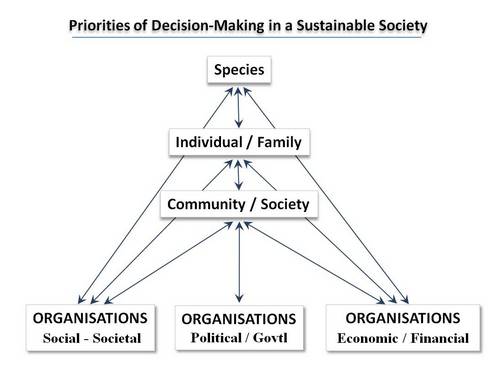
What is not obvious in the illustration above is the distinction between the individual/family and all else that is social. Families and individuals can sustain the species without the social elements of societies, governments, and economies, but societies, governments, and economies cannot sustain themselves without sustainable families that raise the individuals who will become the sustaining innovators, leaders, and decision-makers of those organizations.
- Because families provide the foundation for societies and civilizations, making decisions that support families to become functional and socially sustainable is the premier priority of decision-making for organizations within the social-societal, political-governmental, and financial-economic pillars of functional democratic societies.
- Societal sustainability is not possible until organizations become responsible participants in the symbiotic relationship that supports societies, communities, and the individual/family. By working to teach and train all people how to make socially sustainable decisions we can build socially sustainable families, communities, societies, and nations. Doing so will create a societal system of sustainability: Parents teach their children how to make socially sustainable decisions, who grow up to use that value system in organizational decision-making, that support the development of socially sustainable families, communities, and societies.
15 Pearson, Helen 2016 The Life Project. Soft Skull Press/Counterpoint, Berkeley, CA