
Readers may find it very odd in a paper about the programs of Clinics for Sustainable Families to now read about “transcending the failed history of all societies.” Yet, when the topics of this paper are considered together, a very lucid and insightful thought becomes apparent that would aid the social evolution of every democratic society, while at the same time aiding the social stability of families and communities; and prevent the obvious and eventual failure of those same democratic societies.
As mentioned in previous articles, the social history of all humankind, of every culture and civilization, is littered with failure after failure.5 None have survived functionally intact, though evidence of their past glory remains. They seem to have risen out of nowhere, bloomed, crested, declined, collapsed, and disappeared into the archeological detritus.
Asking the question, “Why did they fail?” would give us quite a long list of factors that contributed to their failure, but the most insightful revelation is not what they did to fail, but what they did not do to assure their continued longevity: None devised a vision, intention, operating philosophy, mission(s), or an organizational learning system to become self-sustaining into a long and distant future. They simply came into existence, then assumed their existence was enough proof to assure them that doing the same would guarantee their existence into the future.
Becoming more powerful, with bigger armies, dominating evermore cultures, and enjoying the prosperity of those times were sufficient evidence to consider anything else as absurd. Yet, our nations today are in the very same situation. The error of all past and present societies and civilizations is that they assume their existence is permanent, rather than planning for the possibility of their transcendence and seeing ways to assure they became self-sustaining. It is not enough for individuals or nations to accept what is, but to aspire to what they can become. Because the present always transcends the past, individuals and nations must devise an intention of what they aspire to, and plan to fulfill their transcendence of the present.
Only with an intention, operating philosophy, and mission for that intention will they become sustainable.
There is a parallel between biologic epigenesis and social epigenesis that has not yet been explored and will be of immense and historic importance to developed societies.
In biologic epigenesis influences early in life imprint in the DNA of the child to unconsciously affect their behavior throughout their life until the child consciously makes a decision concerning his or her behavior. If not, then the imprint will continue in succeeding generations, though fading out with each new generation unless those influences are presented again.
Social epigenesis operates very similarly, but with the social and cultural “DNA” of the whole culture and society. We have seen this with the introduction of electronic technologies since the mid-1980s with personal computers, fax machines, smart phones, the Internet, social media, and many more. They have had an incredible influence that has created social change of exponential dimensions for our cultures and societies.
Imprinting our culture with the influence of electronic technologies has been so subtle that people take the presence of electronics in their life for granted and make decisions accordingly. We have taken for granted this change in our culture without objection, protest, or obstruction to the point where these technologies are assumed as necessary in almost all aspects of our lives. The influence of these technologies has imprinted itself so completely in our “cultural DNA” that we cannot separate our lives from it.
In this example the influence of computer and Internet technologies came into existence unconsciously and unintentionally and particularly without any awareness of the consequences they would have upon all societies and cultures globally. In the case of social epigenesis and the Clinics for Sustainable Families, we can consciously and intentionally bring positive and constructive influences to bear upon new generations, fully aware that the consequences will be the powerful and constructive transgenerational and transformational culture change for all future generations.
Clinics for Sustainable Families, Epigenesis, and Social Transcendence
If we view the work of Jared Diamond as being applicable to our contemporary cultures, societies, and nations, then we are witnessing their social, political, economic, ethical, and moral decline. We are witnessing firsthand the repeat of history, except this time we are witnessing OUR societies in decline.
Though we are very aware of the problems of our cities, societies, politics, and governments those problems are actually observable symptoms of societal decline. We are also witnessing the distancing of the organizations and their executives from those problems and their resolution, and that too, is a symptom of social, moral, and ethical decline that will bring about the eventual collapse of our nations and societies. The existing social-societal, political-governmental, and financial-economic structures are broken and incapable of healing themselves, let alone creating a sustaining system of those structures.
The title of this section, “…Transcending the Failed History of all Societies,”suggests that there is a potential solution in mind. As fixing the problems of our existent societies is not viable, we must create a solution that will empower our societies to adapt to changing conditions and transcend the causes of failure of all prior societies, cultures, nations, and civilizations. Sounds daunting, huh?
Actually creating a solution we can live with is not as impossible as it may seem: We must create the social epigenesis of positive and constructive influences in the whole of every democratic society so that daily decisions by increasing numbers of citizens work toward the greater good of all.
The simplicity of that solution lies with dual approaches
1 First, coupling local community citizens with the multi-generational training and education work of Clinics for Sustainable Families will result in the transcendence of democratic societies. The programs of the
Clinics create the social epigenesis of positive, constructive influences upon the whole society that “bends” the course of the culture over time similarly as electronic technologies have influenced our cultures.
- Local Community Clinics for Sustainable Families would become permanent, operational social institutions in all local communities.
- Clinics would provide classes and training modules via all possible multi-media, plus personal and group venues. The target populations would include all age groups from pre-school to grandparents. Venues would include all Clinics, and educational settings from pre-school to post-graduate. Just as technology classes are provided in most schools, so too would the best practices of parenting, child rearing, child care, family dynamics, and others be provided.
- Multiple generations of training and education through the Clinics would create far more peaceful and socially stable families, communities, and societies, and increase national productivity. The programs of the clinics would have the effect of decreasing social, commercial, and industrial losses due to divorce, family abuse of several different natures, mental/emotional problems, drug abuse, and other causes of loss to productivity.
Caution: I would argue against public education taking on the role and functions of the Clinics as public education has never finished its homework to devise a clear vision and intention for its existence in democratic nations, at least in the United States. The illustration on page 21 provides a hierarchy of decision-making for the vision, intention, and operating philosophy of any and all public social policy development and the function of social institutions.
The skills of effective parenting and child rearing are not hereditary
Training as this has never been recognized as a necessity for our societies, but because of the tremendous effect that bad parenting has on the life of the child-becoming-adult a great waste of the individual’s innate potential is squandered and never shared with their community or society. Our individual and collective empathy and compassion must now come to bear upon this egregious loss.
Some of our citizens have been richly blessed by being raised by parents who seem to have known how to raise effective, socially responsible children who grew into adults and are reasonably well adjusted mentally, emotionally, and socially. Many of our citizens were not raised so conscientiously. Many of the social ills of our “modern” societies, for example child abuse, sexual abuse, elder abuse, alcoholism, drug abuse and addiction, spousal abuse, child and adult delinquency, marital unfaithfulness, gambling addictions, and many more, are almost all attributable to dysfunctional or absent parenting, child rearing, and family skills: The original cause of social-societal, political-governmental, and financial-economic dysfunction and decline.
In any of the healing arts and sciences a choice has to be made: Does the physician treat the symptoms or heal the cause? If we see governmental leadership in the role of healing social problems, then we immediately recognize that governmental programs are almost always palliative at best. The last large-scale curative social program that treated the causes of many social problems in the US was the New Deal initiated by President Franklin Delano Roosevelt. Today’s endemic social problems must be addressed by a far more fundamental cure that begins within the family, with the parents.
What is suggested here, however, addresses the original causes of societal decline by recommending a community-based program of Clinics that helps parents create families of whole individuals who will carry the values that have sustained our species into the organizational structures and social institutions that support a functional, aspiring nation.
2 Second, decision-makers of all organizations need to understand the hierarchy of decision-making that supports the social transcendence of their host societies as shown in the illustration below.
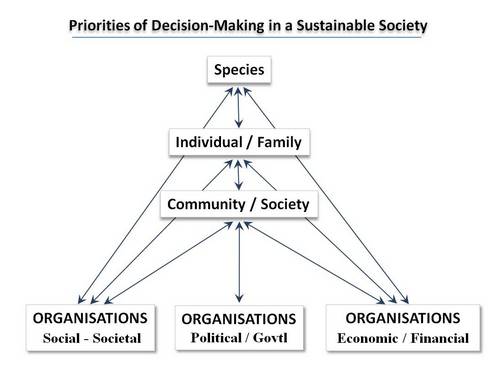
What is not obvious in the illustration above is the distinction between the individual/family and all else that is social. Families and individuals can sustain the species without the social elements of societies, governments, and economies, but societies, governments, and economies cannot sustain themselves without sustainable families that raise the individuals who will become the sustaining innovators, leaders, and decision-makers of those organizations.
♦ Because families provide the foundation for societies and civilizations, making decisions that support families to become functional and socially sustainable is the premier priority of decision-making for organizations within the social-societal, political-governmental, and financial-economic pillars of functional democratic societies.
♦ Societal sustainability is not possible until organizations become responsible participants in the symbiotic relationship that supports societies, communities, and the individual/family. By working to teach and train all people how to make socially sustainable decisions we can build socially sustainable families, communities, societies, and nations. Doing so will create a societal system of sustainability: Parents teach their children how to make socially sustainable decisions, who grow up to use that value system in organizational decision-making, that support the development of socially sustainable families, communities, and societies.
5 Diamond, Jared 2005