
Decision-makers of all organizations need to understand the hierarchy of decision-making that supports the social transcendence of their host societies. What is not obvious in the illustration below is the distinction between the individual/family and all else that is social. Families and individuals can sustain the species without the social elements of societies, governments, and economies, but societies, governments, and economies cannot sustain themselves without sustainable families that raise the individuals who will become the sustaining innovators, leaders, and decision-makers of organizations.

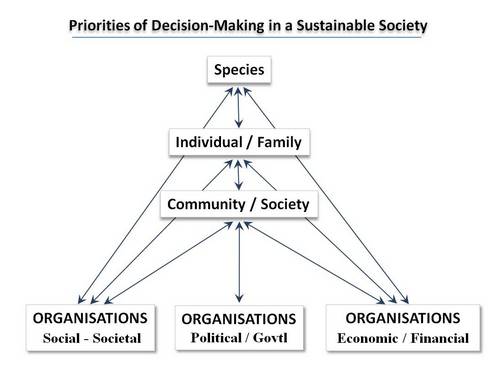
► Because families provide the foundation for societies and civilizations, making decisions that support families to become functional and socially sustainable is the premier priority of decision-making for organizations within the social-societal, political-governmental, and financial-economic pillars of functional democratic societies.
► Societal sustainability is not possible until organizations become responsible participants in the symbiotic relationship that supports societies, communities, and the individual/family.By working to teach and train all people how to make decisions that are socially sustainable we can build socially sustainable families, communities, societies, and nations. Doing so will create a societal system of sustainability: Parents teach their children how to make socially sustainable decisions, who grow up to use that value system in organizational decision-making, that support the development of socially sustainable families, communities, and societies.