
- Introduction
- The colossal marketing mistake of Christian churches
- Clinics for Sustainable Families
- Overcoming recurring social dysfunction
- Transgenerational
- A sustainable Christian church organization
- Priorities of Sustainability
- Organizational development of sustainable Christian churches
- Socially sustainable Christian doctrines
Introduction —
Previously, we established the loving nature of God, God’s relationship to Its mortal children, God’s relationship to Jesus, and removed the irrational tenets of belief to empower us to see God-centered, Christian beliefs as a socially functional belief system. But, where does that leave the Christian church as an organization?
Traditionally, it was good enough for churches to simply proclaim the message of life after death in order to fill the pews and stay in business. In the last century the message of everlasting life has fallen on deaf ears as a concern for almost everyone. Their concerns have shifted from the afterlife to today and tomorrow, where the demands of everyday life, being surrounded by nations at war, and almost constant social instability and turmoil, have made the message of the afterlife and the church seem irrelevant.
Briefly, what has occurred over the centuries of the church’s existence is that the circumstances of life have changed immensely for believers. The Industrial Revolution, world wars, the encroachment of materialism into all areas of life, multiple social and entertainment distractions, and many others factors have shifted the hierarchies of need for billions of people from the quiet lives they once had to the hustle and complexity of contemporary living. For centuries, the hope of an afterlife helped people endure the burdens of survival, but once survival was assured, millions of people began leaving the church.
Although the Church still has as its main mission to bless non-believers with an awareness of God, the afterlife, and the potential of making that transition successfully, it has failed to make itself socially relevant in the larger context of local and national societies. The sustainability of the Church now rests on its capability to re-invent itself to become socially sustainable and a primary, relevant social institution among others. To do that, it must decide to take on the consciously overt mission of becoming socially relevant to families, their communities, and to the larger society. The question for the Church is this, “What perennially useful function can the Church provide that sustains individuals and families, their communities, their larger society, and itself in the coming centuries and millennia?”
Contemporarily that would mean providing a service to parents, and children, as most children will eventually become parents at some point in their lives. The greatest need of contemporary societies is social stability, families that produce socially competent and responsible children, and a multi-generational program to achieve those ends.
The colossal marketing mistake of Christian churches —
How the Church got into its predicament is not complicated. The colossal centuries-old mistake of Christian churches is that they did not have a strategic marketing plan in place. That is completely understandable because for 1,500 years the hierarchy of needs of their audiences had not changed much. Today, the hierarchy of needs of contemporary believers has changed immensely.
Traditional Christian churches have largely failed to market themselves as being practically useful to individuals and families of contemporary societies. Traditional Christian church organizations have not integrated themselves into the function of contributing to the sustainability of their host communities, societies, and nations. Solely addressing the religious faith-needs and spiritual enlightenment of their members once satisfied large populations, but not today.
The church organization’s social, moral, and spiritual responsibilities include more than just teaching and training believers how to save their souls. Historically, church organizations have simply relied upon religious beliefs as sufficient to convince the individual and families to come to church in order to achieve a better life and to assure their “reward in heaven.” That simple marketing tactic is no longer effective. What has been missing from Christianity and related forms of belief is a strategic multi-century marketing plan that places the church organization as the most relevant social institution, except for the family, in the lives of believers in their community.
In every society, the church has a social and moral obligation to help improve the social environment of the community that will enable future generations to become more socially conscious and thus make proactive ethical and moral decisions. The church, as an inclusive organization of a community, has a far heavier moral burden than a hardware store, for example.
Its moral responsibility is also to work to “save the soul” of their local community and society. Doing so will provide a much more positive and constructive social environment for the next generations. By teaching and training parents and children in every generation, the community and larger society will in effect also become enculturated with the best practices of parenting, child rearing, social responsibility, and social justice.
What bonds the beliefs, church organization, and the solution together into a sustaining system are the seven values that have sustained our species for over 200,000 years. When those values become the values for decision-making in church organizations, churches will be able to adapt their functions to the needs of the individual/family, community, and society. When a church organization sees itself as a member of a major pillar that supports a functional society, then their short term goals and long term mission will become easily aligned. (See illustration.)
The key to a millennial strategic marketing plan is to tie organizations to the fundamental elements of human motivation. (ADDENDUM, “Human Motivation,” and “Values, Value Interpretations, Hierarchies of Need, and Social Change.”) When Christian churches make this link, they will become a vital, permanent social institution in every community, with the capability of making meaningful social contributions to the social stability and sustainability of those communities and societies.
To become truly sustainable, Christian church organizations must tie their existence to the social sustainability of the family. The social institution of the family is a never-ending producer of new generations, generations that need to be taught, trained, socialized, and enculturated with the skills of parenting and child rearing. Each new generation provides a new audience for enculturating the best practices of parenting, child rearing, family dynamics, social competency, and social responsibility.
Consider the program discussed below which is more suited for an altruistic venue than a public agency.
Clinics for Sustainable Families 6 —
What is proposed in this section is the establishment of “Clinics for Sustainable Families” within God-centered churches. The “Clinic” is a program of intentional epigenesis to carry forward the best practices of parenting, child rearing, and family dynamics into the next generations.
The mission of Clinics for Sustainable Families is to provide a permanent resource in each community for the enculturation of socially sustainable child rearing and parenting practices. The work of the Clinics is to support the capability of caring and nurturing parents who are interested in their children growing into socially competent, responsible, and resourceful adults. Because the mission of the Clinics is to bring about social stability and eventually social sustainability without a religious, political, cultural, or ethnic bias, the work of the Clinics could be easily adopted by any social institution, organization, or agency with the altruistic mission to uplift the social condition of individuals, families, and communities. While the program of the Clinic is secular and applicable to any altruistic organization, the predominant culture of the organization can provide an overlay to color the context of the program.
The social benefit of these programs will become apparent in the first generation, and highly visible in subsequent generations: parents will have happier and more contented children; parents will be more confident because they are seeing their children become happier, more contented, and socially responsible. The family wins because the dynamics of the family are functional and constructive. The community and the larger society win because their citizens provide for a more stable social existence. And lastly, society and all organizations are provided with future generations of socially functional decision-makers who are capable of devising options, choices, decisions, and courses of implementation using the seven values of our species to support families and communities more effectively.
Overcoming recurring social dysfunction —
The problem of dysfunctional families and dysfunctional societies could be viewed as a “chicken or the egg” conundrum as to which one develops functionality or dysfunctionality in the other. In reality, it is neither. It is my estimation that there never has been a self-sustaining society that influenced the family to also become self-sustaining; and the family has never been a truly self-sustaining social institution that could influence societies to also become self-sustaining.
In the language of social sustainability, there is a symbiotic relationship between families and societies. Sometimes this is a positive relationship and sometimes it is forgotten and left by the wayside of social change. The intention of the article 7 is to present and provide the means for families to become the primary influence for societies to evolve and become socially sustainable.
The crux of the problem is that communities, societies, civilizations, and all of their respective social institutions have come into existence without a conscious intention for their continuing existence or what they were to become. As history has so clearly shown, societies and nations came into existence, bloomed, crested, declined, collapsed, and disappeared into the strata of archeological detritus. 8 To take the initiative of consciously improving the functioning of families as socially sustainable and capable of contributing to the sustainability of community and society would be a first for all time.
Yes, it will take generations to prove the potential of socially sustainable families to effect major culture changes in societies. However, not taking any initiative would provide the assurance that our communities, societies, and nations will fail as assuredly as all have failed in the past, leaving generations in desperation, when we could have given them a better condition for their lives.
Sustainable Family Clinics treat the original causes of personal and social dysfunction — AND — create the original causes of personal and social functioning that results in achievement, personal and social progress and growth, i.e., social evolution that serves the present and all future generations to everyone’s benefit. Crime, addictions, family chaos, adult delinquency and many more ills of society are simply symptoms of social dis-ease, not the causes, that foundations, non-profit organizations, NGOs, governmental and church agencies have been treating for many decades, all without significant results.
What is proposed is the establishment of Clinic programs in Christian churches to teach parents how to use positive and constructive “early life influences” to give their children huge advantages to survive and thrive as they grow into adulthood. Though most parents want the best for their children, it is rare for parents to know what those children can rely upon in later years to serve them well when they are on their own.
Epigenesis. The child care and parenting programs of Clinics would provide parents-to-be, parents, and grandparents with positive child care influences, i.e. skills, that will imprint their child’s DNA, (biologic epigenesis) giving him or her the capability to develop a positive attitude toward life and an anticipation of successes in their life. The imprint is made on the child’s DNA through the instructions of parents and others given to young children in the form of advice, direction, guidance, counsel, instructions, exhortations, and admonishments to the child, and particularly when it is done with consistency.
-------------------------------------------
Viking, Penguin Group, New York
Diamond, Jared 1997 Guns, Germs, and Steel — The Fates of Human Societies W. W. Norton Co., New York
Transgenerational —
A new, permanent social institution is needed to fulfill the possibility of democratic societies becoming stable, peaceful, and eventually socially sustainable. Its permanency is needed for two reasons:
1) To enculturate each new generation with the best practices of conscious and sustainable child rearing and parenting.
2) DNA imprinting is not permanent.
Though one generation may pass these skills on to their children, there is no assurance that those best practices will be permanently embedded in their DNA. These skills will need to be intentionally refreshed in each new generation.
Though the epigenetic DNA imprint created in one generation will carry over to the next generation, it begins to fade with succeeding generations. To aid each generation, those skills and the DNA imprint must be “refreshed” with each new generation, requiring Clinics to become a permanent institution in every community, much like schools of public education. The intentions are multiple, but essentially churches with Clinics would provide a positive, multi-generational benefit to families, communities, and societies.
After numerous generations, it is quite possible that continued imprinting with these best practices would make the imprint more and more indelible. The long term benefit would be the creation of a tremendously supportive social environment for individuals, families, and whole societies. The alternative is a continuation of what we are seeing across America, dysfunction in more social strata of our society from the most indigent to the most affluent. The alternative is to do nothing and let the worst practices of our societies — criminality, violence, and general disregard for the value of others — continue to embed deeper and deeper into our democratic culture and the DNA of our children.
Knowing what we know about the history of societies, our own society, and the obvious signs of the moral and social decay of our society, we are now witnessing the societal decline that always anticipates social collapse. Knowing what we know about the incredible adaptability and durability of our species, and the values that have supported our species’ long existence, we must look at our options, make a choice, invoke a decision, and implement the best practices of our social existence — and transcend the long history of all failed societies. It is doable.
Sources of Child Rearing Wisdom. If we are to create a culture change that provides for the safe social, political, and economic evolution of democratic societies, humbly it must begin within families and the enculturation of each new generation. Discovering the sources of best practices of child rearing and parenthood would go far to help produce children who grow into adulthood to become socially responsible and competent citizens, innovators, leaders, and decision-makers.
Every culture has a set of best practices that, while being cultural, are also universally applicable in all cultures. Raising children who are peaceful, socially responsible, and reasonably contented with life is not a miracle, but the result of conscientiously applying the best practices of child rearing and parenting. Children who are raised that way are far better prepared to integrate the tenets of spiritual enlightenment than children raised in dysfunctional families.
Among every generation of children around the world there are many who have become well adjusted, functionally social, contented, and curious from having been raised by caring and loving parents who somehow knew how to raise their children that way. I truly believe that the wisdom of sound child rearing and parenting practices already exists but simply needs to be collected, organized, collated, and made assertively available in each local community. Discovering what Jesus had to say about parenting, child rearing, family dynamics, and growing up with a God consciousness would be a highly useful bridge between the Clinic program and the religion OF Jesus. Discovering and implementing best practices from all sources would have a profound effect on the civility of our communities and societies, our politics and government operation, as well as financial and economic equity.
Perhaps the most convincing evidence of successful child rearing and parenting skills is in the lives of well adjusted adults in hundreds of cultures around the world waiting to be discovered in field research and a survey of social science research studies. A search for that wisdom would include almost two centuries of social science research, including the work of Margaret Meade whose early research of indigenous cultures could guide our search today.
Though there already exist many parenting and child rearing books, manuals, and articles, none have been validated by the seven values that have sustained our species. Discovering and validating the best practices of child rearing using those values would result in a universal parenting guide that would be applicable to all people of all races, ethnic groups, cultures, religions, and political preferences, without the inherent bias and self-interest of those groups. A universal, multi-cultural guide of those “best practices” would help new parents in all nations raise their children without guessing or assuming they already knew.
A sustainable Christian church organization —
A caution is advised: When considering the development of a sustainable Christian religion and sustainable church organizations, it is vital that one not be confused with the other in order for each to stay true to their separate functions. They are distinctly different from each other, though sharing common values and interests. The religion OF Jesus is based on a belief system that will endure for millennia with or without a man made organization. The challenge here is to design a socially sustainable church organization that has the capability of remaining in existence as an effective and functional organization, not because of the religious faith of its followers, but because it was designed to be selfsustaining.
Societies and communities are not organizational entities, but amorphous aggregations of organizations and groups of people. Because of that, attempts to move a society toward social sustainability will fail until organizations become invested with the values of sustainability as the criteria for their decision-making.
The illustration below describes the social symbiosis that develops in communities and societies that have chosen to move toward social sustainability. The most powerful organizations are those within the three pillars of a functional society: social-societal (where church organizations exist), political-governmental, and economic-financial.
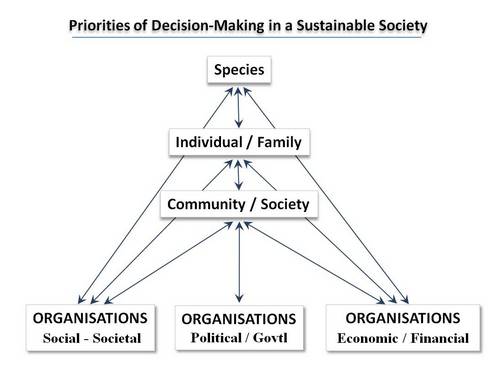
© Copyright Daniel Raphael 2017 USA
The illustration points to those organizations within the three pillars as the primary elements that sustain the community/society, and the individual/family. In other words, without functional organizations, which includes all church organizations, communities and societies will eventually decline and collapse. Historically, this relationship has never been recognized as a necessary element of the relationship between organizations and the individual/family. When we have become conscious of their mutual dependency to sustain their mutual existence, then we have begun to recognize their socially sustainable symbiotic relationship.
Sustaining a conscious and intentional symbiotic relationship between social, political, and financial organizations is vital to sustain a democratic nation. For a society that wants and needs to continue its existence into future centuries, i.e., to become socially sustainable, organizations within those three pillars have a socially sustainable moral obligation to uphold their side of that relationship.
This is a highly foresightful relationship. When we see the holism of our personal, familial, social, and organizational existence, we have come a long way to understanding that maintaining and sustaining this symbiotic relationship will sustain all future generations of families, businesses, churches, and community governments, with an assurance that their existence will be stable, peaceful, and organized so that they enjoy the pattern and order of a socially sustainable nation.
By installing an inclusive Clinic for Sustainable Families within the church organization, to train parents how to become more effective parents and to enculturate their children as socially capable, competent, and responsible individuals, the church will empower those parents and their children to provide a “multiplier effect” for increasing civility, benevolence, and generosity within their community. This enduring strategic marketing plan would need to incorporate the Clinics as a multigenerational service-delivery system that improves the quality of life of the individual and families, while also providing for their spiritual growth and enlightenment. Doing so will assure churches a perennial audience with each new generation. They will have a very positive, cumulative effect on their community for centuries to come.
Priorities of Sustainability —
In a society that is seeking social, political, and economic stability all organizations have a moral responsibility to support the social sustainability of their host communities and societies. This begins with supporting the development of functional, loving family environments using the seven values as the basis for their decision-making.
1. The ultimate priority comes from the genetic mandate to sustain the species.
2. The second priority is to sustain individuals/families to support the continuity of our species and culture. In a society that has chosen to move toward social sustainability, efforts are made to support the maturing social evolution of family dynamics so that families socialize and enculturate the next generations to support a socially sustainable society.
3. The third priority is dependent upon the willingness of organizations within communities and society to adopt socially sustainable values and practices in order to sustain the existence of sustainable communities and societies, beginning with the family/individual.
Contributions by organizations to individuals/families and communities have three symbiotic functions:
1) to aid the sustainability of the species;
2) to aid the sustainability of the individual/family/community; and,
3) to empower individuals, families and communities to reciprocate in that symbiosis by contributing their energies to the sustainability of their mutual society.
Societal sustainability becomes possible when organizations are designed to become sustainable, to stay in business, and make contributions to the continuity of communities and societies by contributing to the sustainability of individuals and families. This symbiosis is only sustainable when individuals and families also make decisions and take actions that support the social sustainability of the organizations of their communities and societies.
An example of an enduring “wisdom” to pass on to each new generation: What the illustration (see above) does not reveal is the innate capability of our species individually and collectively to adapt to changing conditions. This ability stems from our choice-decision to defer the gratification of our wants and needs to a later time and condition. That outcome becomes possible with the foresight to design goals for future completion that provide more fulfillment later rather than in the present moment. Yet, overcoming present uncertain and unpleasant circumstances to achieve future goals is not something every child is taught. It is a necessary choice-decision that can be learned, even by organizations. This is a “wisdom” that is not passed on genetically but shared by an older generation and taught to a younger generation.
Organizational development of sustainable Christian churches —
Church organizations are no different from any other organization: they are man made, and generally have their decisions based on a set of values that are almost always obscure, assumed, and unidentified by management and the organization’s governing body. As history has so abundantly demonstrated, no secular organization has sustained its existence over the course of centuries. Few last longer than a few decades. The obvious conclusion from such a consistent history of failure is that their decision-making was flawed, and the values underlying that decision-making were not those that promote longevity and sustainability.
Yet amidst that history of failure is one entity that has sustained itself for over 200,000 years, the Homo sapiens species. The general consistency of decision-making by the species has supported its sustainability to the present — consistent with that awareness are the values that have sustained that decision-making.
1. The first step is to decide to design a sustainable Christian church organization with the embedded values that have sustained our species. These must be reflected in its founding documents and organizational development. The assumption in doing so is that the church organization would become sustainable much as our species has been.
2. The second step is to actually embed those values into the organizational development of the church organization, whether that is solely a local church or an international church organization:
● Vision statement. What is the vision of the organization as qualified by the seven values? How does the vision statement incorporate the seven values of those who will attend the church over the course of many centuries?
● Intention statement. Historically, this has been called the “purpose statement.” The reason for dissociating from “purpose” is to assure that there is no ambiguity for the existence of the organization and its functions.
● Operational philosophy. This is the statement of beliefs about the functioning of the organization that qualitatively guides the course of decision-making. Operationally, it is the philosophy that prevents the skewing of decision-making over time from the vision of the organization. Examples exist where daily decision-making was “within the margins” of being acceptable, but over time and thousands of such decisions, the result was contrary to the vision and intention of the organization.
These three elements provide the guidance for the organization to sustain its existence into a far distant future. For a Sustainable Christian Religion OF Jesus, the design of related church organizations carry the burden of becoming as sustainable as His message and include empathy, compassion, and a “Love” of humanity, as he taught.
● Mission statement. This is the operational obligation to implement and fulfill the vision statement and intention statement, while being guided by the operational philosophy. This is where the management and market planning come to bear upon daily operations.
● Objectives. These are the measurable operations of the mission statement defined, put into operation, empowered, and monitored.
3. The third step is to design the organization as a Type II, Double Loop Learning Organization. 9
In a Type I Single Loop Organization, when a mistake arises that produces results that are not acceptable, the problem is corrected. In a Type II, Double Loop Learning Organization, the incorrect results are examined to determine the originating causes of the problem; the causes are corrected; and the processes are monitored to see if the cause(s) of the problem were thoroughly corrected.
In the case of the erroneous, illogical, and irrational Pauline theology, the Church did nothing to correct the problem, even though the Jesuits had long ago discovered the gross inconsistencies between the Pauline Theology and the true nature of God. That was a management decision within the organization for reasons that I am unaware. In a Type II, Learning Organization that has chosen to pursue a socially sustainable strategy to more accurately reflect the true nature of God, a problem such as that would have been corrected as soon as it was discovered, whether as a complaint of believers or from an academic within the organization.
Socially sustainable Christian doctrines —
Any new Christian religion that comes into existence in this era of highly educated believers must be able to hold up under examination and scrutiny to provide a system of beliefs that offer the hope of being everlasting. To do that, it must be wholly consistent, reflecting the wholeness and Oneness of The Creator. Its theology, fundamental beliefs, doctrines, and all related instructional materials must have their very beginnings in the roots of the One, beginning before creation. Any contradiction must be resolved, though unresolved issues will always arise to provide the frontier of belief for an evolving religion.
To sustain themselves, God-centered religions must evolve to serve the evolving, growing spiritual needs of believers. To evolve this year, next year, or four centuries from now, it must have a set of values that will permeate its history and carry it into the future. That does not mean the underlying theology and God’s relationship to the believer changes, but that the interpretation of the primary values evolves to serve the evolving social, political, economic, and spiritual needs of their audiences.
While the values that are organic to our species provide for a socially sustaining Christian morality, which supports a loving relationship between the individual believer and God and with all others, it is helpful to also come to some common understandings or doctrines. Consider the following:
1. The Doctrine of Innocence: All children are born morally perfect and without humanly defined sin.
2. The Doctrine of Fallibility: All human children grow from a perfect state of innocence to the point where they will make their first moral decision. It is inevitable that children who have reached this age will make a fallible moral decision.
3. The Doctrine of Perfection: Having made a fallible moral decision, it is our option to decide to strive to become perfect once again. Having made this decision and taken action, our Divine Fragment will do what we allow it to do to help. God's Divine Fragment will give us options so we may choose the right action for our growth.
4. The Doctrine of Separation: God, being perfectly loving and having given sovereignty to the will-decisions of human beings, has provided that those who do not wish to participate in their plan of life and spiritual ascendancy are allowed to pass out of existence, as though they never were.
5. The Doctrine of Wholeness: The universe and its function are whole and unified. All aspects of universe-function operate in oneness, where any one aspect affects the rest, and the whole has an effect upon the single aspect. (The universe does not exhibit "fracturing," where parts operate distinctly from the whole. Only beings with self-will who choose to live outside of wholeness exhibit "fracturing.")
6. The Doctrine of Flow: All aspects that exist in alignment with the greater universe flow in agreement with the universe. "Good" (divine order, divine timing, divine serendipity, and coincidence) is evidence of being in the flow of the universe. The greater our alignment, the greater we are in agreement with the flow of the universe.
7. The Doctrine of Conscious Participation: The rate of development and evolution of our ascendant spiritual career is immensely increased when we consciously participate by making appropriate and timely decisions that are in alignment with the nature of God. Our rate of growth is further augmented when we consciously choose to establish and maintain a co-creative relationship with our Divine Fragment.
♦ ♦ ♦
The world has reached a dramatic climax in its history. … The
world stands on the brink of a great abyss, a terrific regression or
, if it chooses, faces the horizon of a glorious day, a new age.
Ernest Holmes, “This Thing Called You,” page 5.
6 Much of the text for this section originates from an earlier paper, Clinics for Sustainable Families and the
Millennium Families Program, that is fully applicable to Christian Church organizations. Available as a PDF (Link)
7 Ibid.
8 Diamond, Jared 2005 Collapse – How Societies Choose to Fail or Succeed
9 Argyris, Chris. 1985. Action Science, Concepts, Methods, and Skills for Research and Intervention.
Senge, Peter M., 1994. The Fifth Discipline, The Art and Performance of the Learning Organization.